Video by Sonny Vernard
Open the embedded Box content in a new tab
PRISM Health Symposium would not be possible without our sponsors. A huge thank you to these organizations for their support!
2020 & 2019 Sponsors


All photos by Marco Sanchez from UCSF Documents and Media
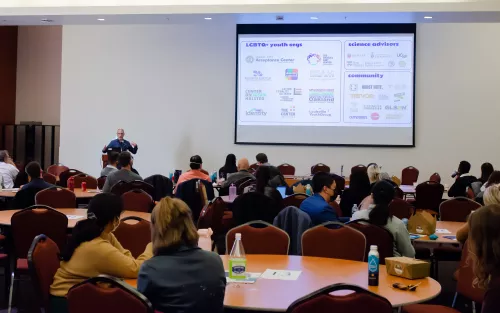
On November 30, 2022, we gathered for the 7th annual PRISM Health Symposium. This year’s symposium was hosted at the Mission Bay Conference Center in San Francisco. Over 60 attendees joined us throughout the day, representing a diverse group of academic researchers and learners.
PRISM founder and co-chair, Dr. Urmimala Sarkar, Professor at UCSF, began with a land acknowledgement to recognize and respect the Ramaytush Ohlone people as traditional stewards of the land that UCSF sits upon.
PRISM co-chair, Dr. Jon-Patrick Allem, Assistant Professor at USC, followed with a brief description of the symposium’s background and goals.

Attendees engaged with each other throughout the event to learn from our speakers engaged in social media and health research.
Poster Session
The poster session began with opening remarks by one of our sponsors, Dr. Joshua Nadeau from Rogers Behavioral Health.
The poster session focused on research from trainees and junior faculty. These posters presented either research in progress or completed research. In total, we learned from 15 poster presentations. View the full list of presenters here.

Panel 1: International Perspectives on Social Media & Global Health
Dr. Alicia Hong, Professor at George Mason University, described her work in conducting a mHealth intervention, Run4Love, on a popular social media platform, WeChat. The intervention aimed to reduce stress and promote physical activity among people living with HIV and depression (PLWHD) in Guangzhou, China. The intervention showed significant improvements in depressive symptoms, reduced stress and stigma, improved quality of life, and positive coping.
Dr. Keshet Ronen, Assistant Professor at the University of Washington, presented her work on the Vijana-SMART study, which leveraged existing WhatsApp groups and youth needs to develop a standardized, moderated WhatsApp intervention that integrates peer and health care worker (HCW) support to improve engagement in care among youth living with HIV (YLWH) in Nairobi, Kenya. Dr. Ronen and the study team found that the intervention was feasible and acceptable.
Dr. Qinghua Yang, Assistant Professor at Texas Christian University, spoke about her research in understanding public health in China using social networking sites (SNSs). Dr. Yang has sought to understand the health information environment on SNSs. Specifically, Dr. Yang shared that SNSs are severely afflicted by misinformation. For example, she found that COVID-19-related misinformation on Weibo is consistent with previous findings of COVID-19 misinformation in other countries.
Panel 2: Stakeholder Engagement
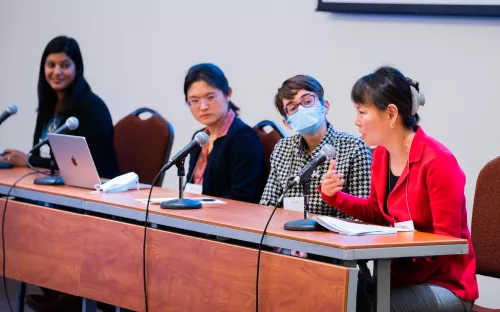
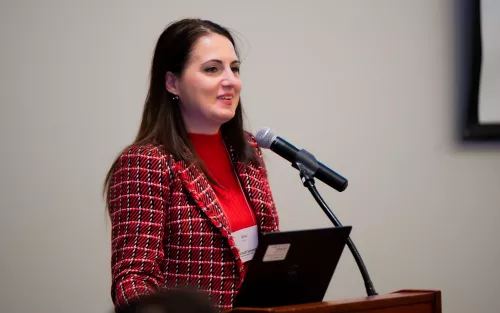
Dr. Ana Radovic, Assistant Professor at the University of Pittsburgh, spoke about bridging technology and mental health to address adolescent suicide. She described various interventions that aim to address depression and suicide. She talked about “Screening Wizard,” a web-based screening tool for adolescents and caregivers, “Text 2 Connect,” a texting intervention designed to improve engagement with mental health treatment, and BRITEPath, a safety planning app for adolescents.
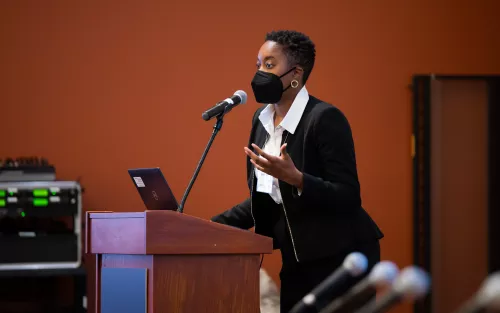
Dr. Kofoworola Williams, Assistant Professor at Drexel University, described her work to design and develop a digital-/social media-based mental health intervention. Dr. Williams conducted focus groups with 20 Black men to identify social and contextual factors impacting mental health risk and willingness to engage in help-seeking. Dr. Williams also conducted semi-structured interviews with 11 Black men to identify their needs, preferences, and acceptability in using mobile and social media for their mental health needs.
Content Moderation on Social Media Platforms
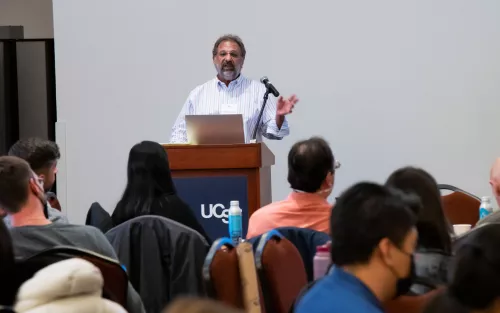
After lunch, we were brought back together to learn from Dr. Joseph B. Walther, Distinguished Professor in Communication at UC Santa Barbara. Dr. Walther’s talk covered online hate speech. He shared that a previous perspective for an individual motivation to promote online hate speech was to antagonize a target. Dr. Walther offered a new perspective: the motivation behind online hate speech is “to entertain like-minded peers and garner social approval.”
Rapid Fire Session
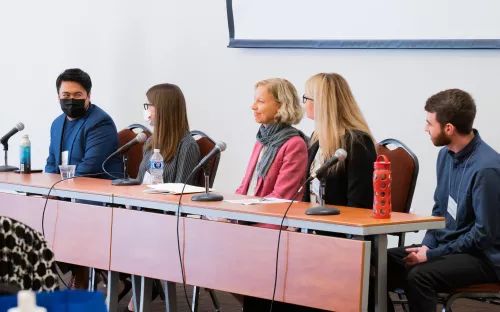
Rapid-fire presentations focused on research from trainees and junior faculty, presenting on research in progress or completed research. In total, we learned from 5 rapid-fire presentations. View the full list of presenters here.
Closing Remarks
Fred Dillon, Head of Advisory Services at Hopelab, delivered closing remarks. Hopelab is a social innovation lab and impact investor at the intersection of tech and youth mental health. Mr. Dillon shared two of Hopelab’s current efforts: imi.guide and Quit the Hit. Mr. Dillon shared how Hopelab has leveraged social media to get the word out about imi and how they’ve leveraged the platform of Instagram to create the Quit the Hit experience.
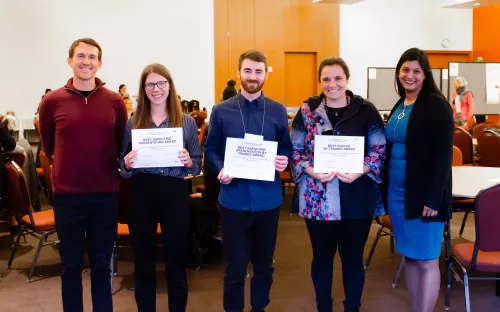
PRISM 2022 Awards
Best Rapid-Fire Presentation by a non-trainee: Erin Vogel, PhD
Best Rapid-Fire Presentation by a trainee: Marco Zenone, MSc
Best Poster Presentation by a non-trainee: Alicia Hong, PhD
Best Poster Presentation by a trainee: Elyse Thulin, PhD
Special thanks to our co-host, Hopelab; sponsors (UCSF Helen Diller Family Comprehensive Cancer Center, Rogers Behavioral Health, and Dr. Eleni Linos); steering committee (Dr. Urmimala Sarkar, Dr. Jon Patrick-Allem, Dr. Sylvia Chou, Dr. Valentin Danchev, Dr. Michael Deiner, Dr. Sunny Liu, Dr. Tim Mackey, Dr. Meredith Meacham, Dr. Thu Nguyen, Dr. Molly Waring, Thomas Bukowski, Dr. Cesar Escobar-Viera, Dr. Pamela Ling, and Dr. Philip Massey); event staff (Leslie Avilez, Marika Dy, Vlad Honcharov, Kristan Olazo, and Jeanette Wong); ETS (Dorothy Wang); MBCC staff (Darla Parks and Emily Lefson); photography (Marco Sanchez); and catering (Moffitt Catering).
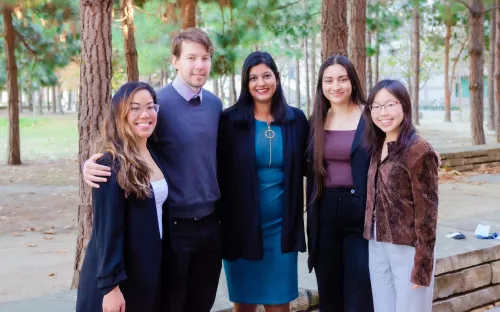
Thank you from the UCSF PRISM team!
Thank You Sponsors
The PRISM Health Symposium would not be possible without our sponsors. A huge thank you to these organizations for their support!